By Milo Durrance
Weapons (2025) is the second feature directed by Zach Cregger. It’s deeply frightening and heartbreaking, yet also funny. The film starts with a voiceover by a child, explaining how at 2:17 AM, seventeen kids in Ms. Gandy’s class got out of bed, ran into the darkness and never came back. The film unfolds through six interconnected vignettes, each told from a different character’s perspective.
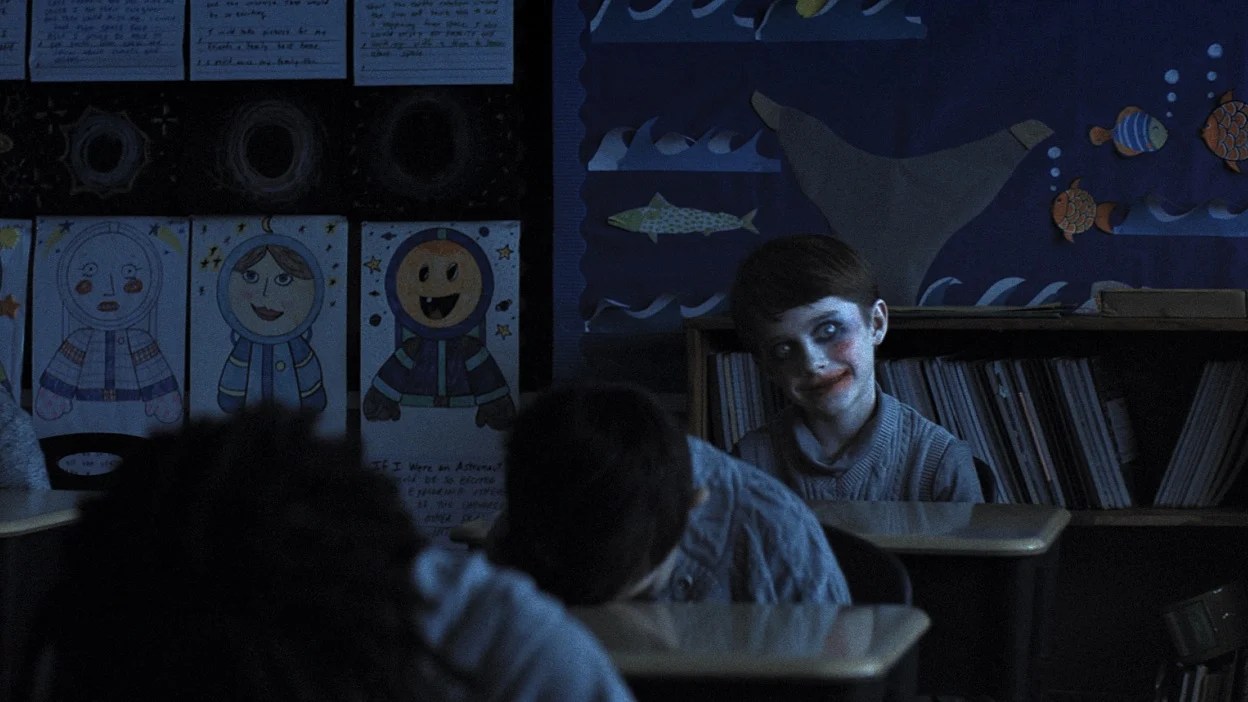
Alex (Cary Christopher) is the last child remaining from Ms. Gandy’s class and the protagonist of the last segment of the movie. Gladys (Amy Madigan) is Alex’s sinister great-aunt who is behind the disappearance of his classmates. There are glimpses of her throughout the movie, but she becomes a primary character in the final segment.
Gladys is a new and terrifying force in Alex’s life. She moves into Alex’s house, taking control of his parents and becoming Alex’s only guardian. There are many ways to interpret Gladys’s character, but what is especially interesting is the way she can be read as the embodiment of addiction through the eyes of a child.
One day, after Gladys has come to stay with Alex’s family, no one comes to pick him up from school. He walks home to find his parents sitting at the dinner table across from each other. They talk to Alex in an atypical quiet monotone. He tries to get them to react, throwing a cup of water at his dad’s face, but it elicits no response. Gladys tells Alex that he cannot let anyone know about what is happening in the house.
While Gladys exists within the heightened reality of a horror movie, there are parallels that can be drawn to real life. She takes over Alex’s parents like an addiction, incapacitating them in a way he can’t understand. Alex’s parents now act strangely and are unable to take care of him. His parents aren’t the villains and their condition is not their fault, instead they have been taken over by an external force. Cary Christopher delivers a devastating performance as Alex. Though he rarely speaks, his eyes hold a lot of pain. In a particularly effective image, Alex goes to the grocery store to buy cans and cans of soup, because Gladys has tasked him with feeding her victims. He goes about this routine of buying soup and spooning it into his parents’ mouths. The cans pile up in the trash. He can’t be much older than nine, but he’s forced to take on the responsibility of keeping his parents and the kids from Ms. Gandy’s class alive. This is a parallel to growing up in neglectful households; growing up with parents who struggle to take care of themselves, let alone their own children.
Despite everything, Alex needs to keep up the pretense of normality. He goes to school, he goes to the grocery store, he walks home. He moves through his life robotically after Gladys takes over. Children living with abusive or addicted parents often don’t want to express the reality of their situation. On top of that, the system in place to protect children in these scenarios is not perfect, something that is expressed in the movie through Alex’s interactions with police. He faces scrutiny being the last kid left in his classroom. Law enforcement visits his house after the disappearance of his classmates. The officer remarks that Alex is very quiet, but they don’t think to intervene in any way.
In the end, Gladys is killed by her own magic. Alex learns how to conduct it and sends the kidnapped children running after Gladys. They tear her to pieces. After Gladys dies, the spell she cast is undone, but the effects still linger. The children from Ms. Gandy’s class remain catatonic. At the end, the narrator reflects on the events of the movie, saying, “Some of them even started talking again this year.” Alex’s parents, who spent the most time under Gladys’s spell, have to live in an institution. This is similar to how addiction continues to impact people’s health and relationships even when they enter recovery. It’s not as simple as defeating the evil force; the harm Gladys inflicted reverberates throughout people’s lives after the movie ends.
The vast majority of the time, horror movies exist within the realm of fantasy. Even movies more realistic than Weapons take an exaggerated look at horrible events. This is both the power of horror movies and where they can fall short. The distance from reality that horror movies have can make them either effective metaphors, or less emotionally investing. Weapons strikes a tonal balance that isn’t easy to achieve, mixing fantasy and comedy with the reality of domestic abuse and trauma. Through this, Weapons gives a compelling examination of the effects of addiction while remaining a fun and engaging horror story.
 CinemaRoll