By Micah Hervey
Harmony Korine has often been labeled as a nihilistic filmmaker, and it’s easy to see why. Almost all of his movies, including Spring Breakers (2012), Julien Donkey Boy (1999), and Gummo (1997), paint a very bleak portrait of the world. Terrible things happen almost as if they’re inevitable, and Korine never seems to present a solution. Bad shit happens, and you can’t do anything about it. In Gummo, children kill cats and sniff glue; a disabled girl is pimped out by her husband, and so on. All this is presented as if it’s just a part of the world. There’s no hope of things changing, and seemingly no moral center. But if you look closely enough, there is a moral center to Gummo, just not in a traditional sense.
By not trying to convey some kind of moralistic message through its narrative, it does so in a more authentic manner than a film with that goal in mind could. As traditionally described by the Greeks, ethics are concerned with how to live a good life. They provide a set of guidelines that, if followed, will lead to happiness in the long term. Harmony Korine chooses to examine characters who don’t follow a traditional set of morals or ethics, but he doesn’t judge them for it, and he expresses a tremendous amount of empathy for all of them. He lets them be. At the same time, by letting these characters just be, exist as true to themselves, certain truths arise. Tummler (Nick Sutton), as described by his accomplice Solomon (Jacob Reynolds), is evil. He’s a nihilist who constantly seeks destruction. He tortures cats and takes an old woman off her ventilator, and Korine doesn’t punish him for it. He doesn’t carefully craft a narrative that leads to him either changing or being punished for his actions in the end. The last we see of him in the movie, he’s repeatedly shooting a dead cat, the same as how he started. But letting Tummler just be is punishment enough for the character. His complete abandonment of ethics and morality, and full embrace of nihilism, are aspects of his miserable existence.
Throughout Gummo, we catch glimpses of Tummler’s journal, where one entry reads as a suicide note:
Dear world, I have confusion around me in every direction from my brain. I’ve tried and tried it here in this fucking world… but I think it was a mistake that I was ever born. I do not feel guilty about taking my own life. I’ve tried your ways… making a living was never a problem for me. The problem was, all I see is misery and darkness.
It’s possible that after the events of the film, Tummler takes his own life; it’s also possible he doesn’t. Either way, the letter reveals the internal hell this character lives in. It reflects an internal hell that matches the actions of someone who acts in this manner.
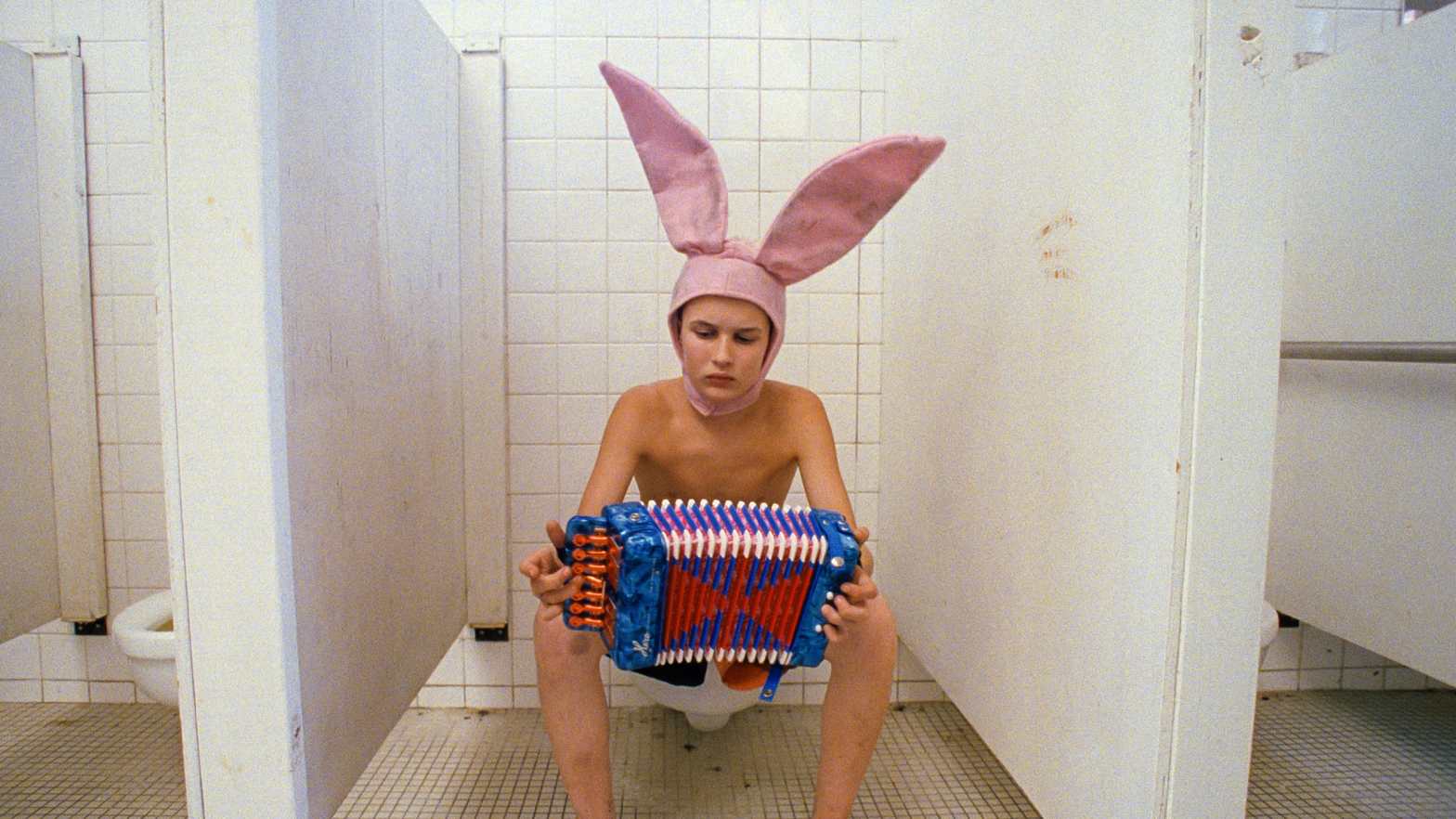
On the opposite end of the spectrum, Gummo also follows a group of sisters. These sisters, Dot (Chloe Sevingy), Helen (Carisa Glucksman), and Darby (Darby Dougherty), are presented as happy, empathetic people. This can be seen through how they generally act, but also in how their treatment of cats contrasts with Tummler’s. The very first scene we see of Tommer, he almost shoots a cat, but his friend, Solomon, stops him because it’s a house cat. That cat is then revealed to belong to the sisters. They treat the cat like one of their own and, once it goes missing, they spend the majority of the film searching for it. This plot intercuts with scenes of Tummler killing and torturing cats. In the final scene, it’s the girl’s cat that Tummler shoots repeatedly. But as he looks down miserably at the dead cat, the girls play and make out with Bunny Boy(a different recurring character played by Jacob Sewell) in a backyard pool. Tummler’s left in his inescapable pit of hatred, while the girls experience a moment of joy. And even though they might be sad when they find out their cat is dead, the sisters will be alright because they have a love for each other, which translates to a love of the world. A love that Tummler doesn’t have.
It’s fair to say that Korine doesn’t judge Tummler. The empathy that Korine has for his character comes through in spades. Throughout Gummo, we experience the violent environment and the void of love that Tummler grew up in, making it almost impossible to blame him for his actions. But when you look at the full picture of Tummler’s character by the end of the film, it’s clear that even if Korine doesn’t judge him for his actions, the world will.
 CinemaRoll