By Jasira Gay
A few days ago, I was able to watch Sinners (2025) at the Purchase Film and Media Studies (FMS) screening. Now granted, I knew about Sinners a few months ago when it was taking over the world, but I had yet to watch it until late August on HBO Max at home. Safe to say, the critics and audiences were completely right about this movie. It was stunning, charming, and culturally present. However, watching the movie with an audience compared with watching it at home alone was a beautiful experience. With the movie being so well received and popular with many audiences, tickets for Sinners sold out at Purchase College within a day.
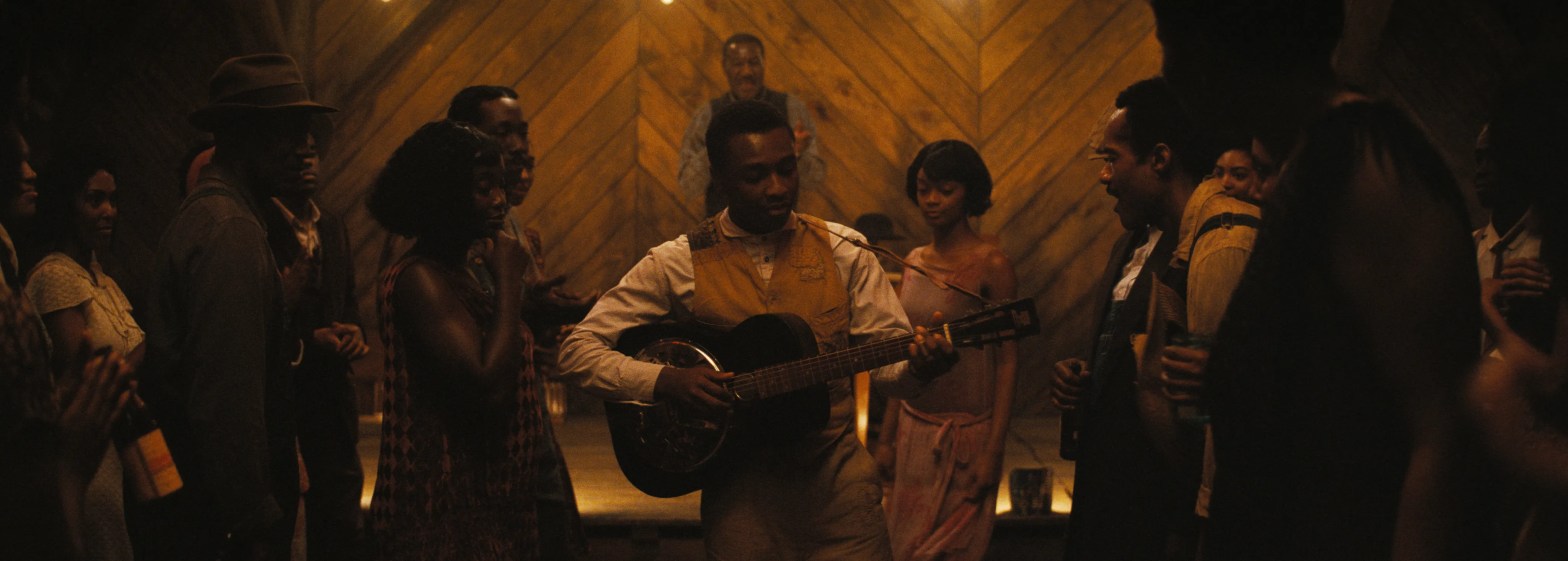
Sinners graced our theaters, fully shedding light on generational trauma, the impact of culture, and how to break the patterns of trauma racially with music and soul. Sinners follows Samuel Moore, played by Miles Caton, a young, black, aspiring, blues player and singer during the early 1930s in Mississippi. As his preacher father, played by Saul Williams, warns him against playing the blues, he’s interrupted by his twin nephews, Elijah “Smoke” and Elias “Stack,” both played by Michael B. Jordan, who both came back from Chicago to open up a juke joint in their hometown. Samuel decides to join the twins, and as night falls, light starts to shed on the sinister beings hidden in the dark. Director Ryan Coogler perfectly encapsulates the true aspects of film, making something that feels so foreseen, and yet familiar in not only American history, but the history of the world and the culture that has been and is being carried by us. From West African culture, to Chinese culture, to Irish Culture, and Choctaw culture, Coogler creates an atmosphere where many cultures play their own roles in the story, reflecting the story of oppression, reflection, and how music can tie us together. Blues is the true heart of the story. In one scene in particular, Miles performs for the first time at the Juke Joint, which in turn brings out this soothing yet electric and powerful scene where the past and future ghosts of music mix together. Highlighting that our past made us who we are culturally, and the present is something that the future is becoming.
Although for me personally, watching that scene for the first time will never quite feel the same watching it again, I was still struck by the scene during the screening. With tears welling up in my eyes, I was grateful to be able to witness something so beautiful, and realized that everyone, including me, who was at the screening, saw our real culture that made us who we are, uniting us in that moment. Overall, the viewing experience was splendid. Every joke landed with the audience, even though the majority had already watched the film. I could even recall hearing people quietly sing and hum some of the songs from the film. I mean, I did too. How can you not? When Sinners first came out, everyone I knew said watching it was “An Experience.” That statement is true to me, even months later. At its heart, Sinners is about embracing the past, but overcoming it in order to embrace the future, openly, culturally, and unapologetically.
 CinemaRoll